Tag Archive for ‘first aid’

Emergency Preparedness For Reptiles & Amphibians

The anniversaries of 9/11 and Hurricane Katrina remind me how important it is that we plan to care for our whole family for an extended period of time in the event of a natural or man-made disaster.  This is a good time to get started.  This post has been a long time coming and was researched consulting the AVMA, FEMA, ASPCA, HSUS, CDC, Petfinder, & more.  I hope you find it useful!  (I ask that if you re-post it, that you give credit to & link to PetProject.)

It’s not that I’m all gloom and doom. It’s just that in the event of a disaster, I don’t want to be forced to rely on other agencies, if I can help it, and I know my pets will be safest under our care, so I’m working to be as prepared as possible. I live in earthquake country and we have a kit to take care of everyone in our family—human, feline, and canine. Getting prepared has been an ongoing process so I can spread out the cost and spread out the time & energy spent on the project.

Make sure your whole family is taken care of and do not leave your pets to fend for themselves. Keep them with you. If you evacuate and think you’ll only be away from your home a short time, take your animals with you! You don’t know when or if you’ll be able to return to your home.

I’ve divided the list into categories and put a ♥ by the items to start with first. Don’t get overwhelmed. Begin with the ♥ items and once you have those, set a goal—maybe 1-2 items every other week? And begin by gathering at least 3 days worth of supplies and work up to 1-2 weeks. Defray the costs by checking thrift stores and looking for sales.

Tasks:

  1. ♥Microchip your animal if possible
  2. ♥Talk to your vet about obtaining medication for your emergency kit
  3. ♥Put together Herp First Aid Kit
    1. Drs. Foster & Smith’s list
    2. Melissa Kaplan’s list
  4. Place “Pets Inside” stickers at each entrance to your home listing what types of animals you have & how many—here’s where you can get a free decal
  5. Develop a plan that doesn’t rely solely on public emergency shelters (most won’t allow animals)–we plan to keep our pets with us, so we have a tent, etc.
  6. Petfinder has a number of useful links for finding pet friendly motels/hotels—identify nearby options & options outside your local area
  7. Coordinate with a nearby friend or trustworthy neighbor to take care of your pets in case something happens while you’re away from your home (make sure your friend or neighbor is familiar with your pets & that your pets are comfortable with them, give them a key & care information for your pets, be clear about your arrangement—will they just feed & water your pets at your house, will they take custody of your pets, etc.)
  8. Find out if your vet will board animals in the event of an emergency
  9. Contact your local animal control & humane society about their disaster plan (what services they plan to provide, where they intend to be located)
  10. Plan to keep your pets separate from each other—animals under extreme stress or in pain can be unpredictable and your dog could attack your lizard, etc.
  11. If you live in a disaster prone area:
    1. consider an automatic feeder if appropriate
    2. consider using a large waterer
    3. if you are likely to evacuate, find an herp vet in that area ahead of time
    4. learn about coping with evacuation gridlock
    5. make sure you’ve planned for space in your vehicle for your pets
  12. Familiarize yourself with what to do in an emergency
    1. the AVMA has a superb manual
    2. the Humane Society has good tips, including dealing with everyday emergencies
    3. Special tips for preparing for tornados

      Documents:

      1. ♥up-to-date medical records
      2. ♥proof of ownership—pet license records, adoption forms, registration papers, etc.
      3. ♥recent photos of all your pets, include distinguishing marks (for lost posters, online notices)
      4. ♥photos of you with your pets (documenting they are your pets)
      5. detailed descriptions of your pets

      Items:

      1. ♥contact information for:
        1. your veterinarian
        2. emergency veterinarian
        3. area shelters
        4. ASPCA Animal Poison Control 1 (888) 426-4435
      2. ♥sturdy, escape-proof traveling cage or carrier or plastic tub with air holes (smooth off any burs made by drilling holes to avoid injury to amphibians)—make sure whatever you use fits in your car
      3. ♥suitable substrate
      4. ♥blanket to cover cage
      5. ♥sturdy bowl large enough for animal to soak in
      6. ♥battery operated heating source or hot water bottle
      7. ♥appropriate battery operated lights
      8. ♥extra batteries/heavy duty electrical cord (consider getting a generator if you have several animals)
      9. ♥thermometer for cage
      10. ♥manual can opener
      11. ♥food bowls
      12. ♥water bowl
      13. ♥spray bottle for misting water
      14. ♥1-2 weeks of food (feeding during evacuation may add to some animal’s stress so feeding may not be in some reptile/amphibian’s best interest during stress according to the AVMA)
      15. ♥canned fruit & vegetables in natural juice, no salt added –OR– baby food jars of fruit & vegetables
      16. ♥1-2 weeks water (not distilled)
      17. ♥dietary supplements
      18. ♥live food (remember to plan for care for your live “food”)
      19. ♥dechlorination drops
      20. ♥current Herp First Aid Manual
      21. styrofoam cooler to insulate pet in its cage
      22. newspapers
      23. handling gloves
      24. disposable gloves
      25. plastic bags
      26. paper towels
      27. disinfectant
      28. dish soap
      29. dish brush
      30. towel

          Emergency Preparedness For Birds

          (Want to make these birdies?  Check out this post!)

          The anniversaries of 9/11 and Hurricane Katrina remind me how important it is that we plan to care for our whole family for an extended period of time in the event of a natural or man-made disaster.  This is a good time to get started.  This post has been a long time coming and was researched consulting the AVMA, FEMA, ASPCA, HSUS, CDC, Petfinder, & more.  I hope you find it useful!  (I ask that if you re-post it, that you give credit to & link to PetProject.)

          It’s not that I’m all gloom and doom. It’s just that in the event of a disaster, I don’t want to be forced to rely on other agencies, if I can help it, and I know my pets will be safest under our care, so I’m working to be as prepared as possible. I live in earthquake country and we have a kit to take care of everyone in our family—human, feline, and canine. Getting prepared has been an ongoing process so I can spread out the cost and spread out the time & energy spent on the project.

          Make sure your whole family is taken care of and do not leave your pets to fend for themselves. Keep them with you. If you evacuate and think you’ll only be away from your home a short time, take your animals with you! You don’t know when or if you’ll be able to return to your home.

          I’ve divided the list into categories and put a ♥ by the items to start with first. Don’t get overwhelmed. Begin with the ♥ items and once you have those, set a goal—maybe 1-2 items every other week? And begin by gathering at least 3 days worth of supplies and work up to 1-2 weeks. Defray the costs by checking thrift stores and looking for sales.

          Tasks:

          1. ♥Microchip or band your bird if possible & keep the registered contact information up-to-date
          2. ♥Talk to your vet about obtaining medication for your emergency kit
          3. ♥Construct an Avian First Aid Kit 
            1. Drs. Foster & Smith First Aid List
            2. AvianWeb First Aid Kit List
          4. Place “Pets Inside” stickers at each entrance to your home listing what types of animals you have & how many—here’s where you can get a free decal
          5. Make up “Lost” posters for your pets (in case they get lost) with space for up-to-date contact information if you’ve evacuated, here’s a form that will create a poster for you
          6. Develop a plan that doesn’t rely solely on public emergency shelters (most won’t allow animals)–we plan to keep our pets with us, so we have a tent, etc.
          7. Petfinder has a number of useful links for finding pet friendly motels/hotels—identify nearby options & options outside your local area
          8. Coordinate with a nearby friend or trustworthy neighbor to take care of your pets in case something happens while you’re away from your home (make sure your friend or neighbor is familiar with your pets & that your pets are comfortable with them, give them a key & care information for your pets, be clear about your arrangement—will they just feed & water your pets at your house, will they take custody of your pets, etc.)
          9. Find out if your vet will board animals in the event of an emergency
          10. Contact your local animal control & humane society about their disaster plan (what services they plan to provide, where they intend to be located)
          11. Plan to keep your pets separate from each other—animals under extreme stress or in pain can be unpredictable and your dog could attack your bird, etc.
          12. If you live in a disaster prone area:
            1. consider using a feeder on a timer
            2. consider using a large waterer
            3. if you are likely to evacuate, find an avian vet in that area ahead of time
            4. learn about coping with evacuation gridlock
            5. make sure you’ve planned for space in your vehicle for your pets
          13. Familiarize yourself with what to do in an emergency
            1. the AVMA has a superb manual
            2. the Humane Society has good tips, including dealing with everyday emergencies
          14. Special tips for preparing for tornados

          Documents:

          1. ♥up-to-date vaccination records (could help in your obtaining shelter)
          2. ♥proof of ownership—pet license records, adoption forms, registration papers, etc.
          3. ♥recent photos of all your pets, include distinguishing marks (for lost posters, online notices)
          4. ♥photos of you with your pets (documenting they are your pets)
          5. detailed descriptions of your pets

            Items:

            1. ♥contact information for:
              1. your veterinarian
              2. emergency veterinarian
              3. area shelters
              4. ASPCA Animal Poison Control 1 (888) 426-4435
            2. ♥sturdy traveling cage or carrier marked with identification & contact information—make sure whatever you use will fit in your car
            3. ♥blanket to cover cage (for warmth or to reduce stress)
            4. ♥sheet to cover cage in warm weather
            5. ♥towel
            6. ♥1-2 weeks supply of cage liner
            7. ♥paper towels
            8. ♥spray bottle of water (to mist bird)
            9. ♥manual can opener
            10. ♥1-2 weeks of food
            11. ♥1-2 weeks of water
            12. ♥canned fruit & vegetables in natural juice, no salt added –OR– baby food jars of fruit & vegetables –OR– organic, unsweetened apple sauce
            13. ♥current Avian First Aid manual
            14. hot water bottle (for warmth)
            15. almonds in shell for treat
            16. dietary supplements
            17. cuttlebone/beak conditioner
            18. wooden chew pieces
            19. finger traps for shredding
            20. toys
            21. spray bottle of vinegar for cleaning
            22. spoon
            23. dish soap
            24. dish brush
            25. Pedialyte
            26. net or blanket for catching escaped bird
            27. wire (repair cage if needed)
            28. pliers (repair cage if needed)
            29. zip ties to secure doors on cage/carrier

                Emergency Preparedness For Your Pets

                Note:  Hurricane Irene has me thinking about disaster preparedness so I’m reposting this.  It a good reminder that we should all be prepared for an emergency, so I challenge you to start your emergency preparedness kit this weekend for your whole family—pets included!  Our thoughts are with those on the East Coast and we’re hoping for the best.

                The anniversaries of 9/11 and Hurricane Katrina remind me how important it is that we plan to care for our whole family for an extended period of time in the event of a natural or man-made disaster.  Turns out September is National Preparedness Month, so this is a great time to start getting prepared.  This post has been a long time coming and was researched consulting the AVMA, FEMA, ASPCA, HSUS, CDC, Petfinder, & more.  I hope you find it useful!  (I ask that if you re-post it, that you give credit to & link to PetProject.)

                It’s not that I’m all gloom and doom. It’s just that in the event of a disaster, I don’t want to be forced to rely on other agencies, if I can help it, and I know my pets will be safest under our care, so I’m working to be as prepared as possible. I live in earthquake country and we have a kit to take care of everyone in our family—human, feline, and canine. Getting prepared has been an ongoing process so I can spread out the cost and spread out the time & energy spent on the project.

                Make sure your whole family is taken care of and do not leave your pets to fend for themselves. Keep them with you. If you evacuate and think you’ll only be away from your home a short time, take your animals with you! You don’t know when or if you’ll be able to return to your home.

                I’ve divided the list into categories and put a ♥ by the items to start with first. Don’t get overwhelmed. Begin with the ♥ items and once you have those, set a goal—maybe 1-2 items every other week? And begin by gathering at least 3 days worth of supplies and work up to 1-2 weeks. Defray the costs by checking thrift stores and looking for sales—buy an extra bag of cat litter when it’s on sale, etc. Some of the items listed will double for a human preparedness kit.

                Tasks:

                1. ♥Microchip every animal & keep the registered contact information up-to-date
                2. ♥Make sure your pets have collars and up-to-date ID tags, consider adding an out-of-state contact phone number too (it’s recommended families have an out-of-state contact (relative or friend) because when phone lines are flooded with calls, it’s sometimes easier to reach someone out of the area.)
                3. ♥Talk to your vet about obtaining medication for your emergency kit
                4. ♥Construct a First Aid Kit (I’ve compiled a comprehensive list for a well stocked kit)
                5. Place “Pets Inside” stickers at each entrance to your home listing what types of animals you have & how many—here’s where you can get a free decal
                6. Make up “Lost” posters for your pets (in case they get lost) with space for up-to-date contact information if you’ve evacuated, here’s a form that will create a poster for you
                7. Develop a plan that doesn’t rely solely on public emergency shelters (most won’t allow animals)–we plan to keep our pets with us, so we have a tent, etc.
                8. Petfinder has a number of useful links for finding pet friendly motels/hotels—identify nearby options & options outside your local area
                9. Coordinate with a nearby friend or trustworthy neighbor to take care of your pets in case something happens while you’re away from your home (make sure your friend or neighbor is familiar with your pets & that your pets are comfortable with them, give them a key & care information for your pets, be clear about your arrangement—will they just feed & water your pets at your house, will they take custody of your pets, etc.)
                10. Find out if your vet will board animals in the event of an emergency
                11. Contact your local animal control & humane society about their disaster plan (what services they plan to provide, where they intend to be located)
                12. Plan to keep your pets separate from each other—animals under extreme stress or in pain can be unpredictable and your dog could attack your cat, etc.
                13. If you live in a disaster prone area:
                  1. consider putting a leash at every exit to your home, if you have a dog
                  2. consider using a feeder on a timer
                  3. consider using a waterer with a reservoir
                  4. if you are likely to evacuate, find a vet in that area ahead of time
                  5. coping with evacuation gridlock
                  6. make sure you’ve planned for space in your vehicle for your pets
                14. Familiarize yourself with what to do in an emergency
                  1. the AVMA has a superb manual
                  2. the Humane Society has good tips, including dealing with everyday emergencies
                15. Special tips for preparing for tornados


                Documents:

                1. ♥up-to-date vaccination records (could help in your obtaining shelter)
                2. ♥pet license records
                3. ♥recent photos of all your pets, include distinguishing marks (for lost posters, online notices)
                4. ♥photos of you with your pets (documenting they are your pets)
                5. detailed descriptions of your pets


                Items:

                1. ♥1-2 weeks worth of food (wet & dry–small cans of wet since you can’t refrigerate them)
                2. ♥1-2 weeks of water for just your pets
                3. ♥2 bowls
                4. ♥manual can opener
                5. ♥spoon (for food)
                6. ♥litter box
                7. ♥1-2 weeks supply of cat litter
                8. ♥litter scoop
                9. ♥poop bags
                10. ♥ID tags with space to put up-to-date information (in case you’ve evacuated)
                11. ♥sturdy, extra leash (for each animal)
                12. ♥sturdy, extra collar (for each animal)
                13. ♥sturdy, extra harness (for each animal that they can’t slip out of)
                14. ♥carriers/crates (for each animal in appropriate sizes)
                15. bedding
                16. large garbage bags
                17. tie out/stake(do not leave dog unattended, ever)
                18. long line leash
                19. muzzle (cat & dog, helpful in case of injury, may help you obtain shelter for you & your pets)
                20. toys
                21. paper towels
                22. dish soap
                23. dish brush
                24. disinfectant for cleaning crate, etc.
                25. pet shampoo
                26. grooming supplies
                27. bath towels
                28. blanket (to capture a skittish pet, cover a stressed pet, immobilize a pet for treatment)
                29. treats
                30. chew treats
                31. hand truck, cart, or wagon (this could be especially important if you have a number of animals or a large dog and need to move them to another location while crated and don’t have use of a car)

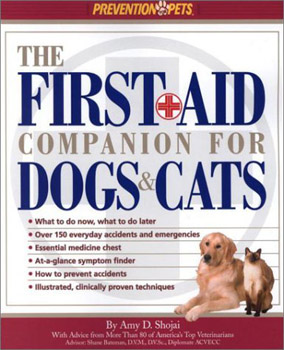
                We Like: The First Aid Companion For Dogs & Cats

                I was a Girl Scout and I took their motto, “Be prepared”, to heart.  I am so prepared and you can be too.  The First Aid Companion For Dogs & Cats will help.  Our pets never seem to have health problems while our vet is open.  It’s always late on a Saturday night or on a holiday.  This book is so handy at those times for letting me know if we need to seek immediate care or if a visit to the vet can wait or is even necessary.

                The book was written by Amy D. Shojai with input from over 80 veterinarians.  It has good illustrations instead of photos, which I like because photos of horrible wounds can keep some people from using a book.  The injuries and conditions are presented in alphabetical order, which makes it easy to find information even if you’re panicking.  There’s also an index if that works better for you.

                One of the things that separates this book from others I’ve seen are the thoughtful sections at the beginning.  You should read this part of the book before an emergency happens.

                • The first section covers what you should have in your medicine cabinet & first aid kit and includes a thorough section on medications for humans that can and can’t be used with cats and dogs.
                • The second is a great section on how to assess the emergency by checking things like capillary refill time by pressing your finger on your pet’s gums and counting how long it takes to turn pink again.  There’s even a chart showing how many seconds is normal, how many seconds means you should call the vet, and how many seconds means it’s an emergency.
                • The third section teaches how to do basic things like restraining your pet, bandaging, and CPR–including an acupunture point that can aid in resuscitation by releasing adrenaline.
                • I like that the fourth section describes how to prevent problems in the first place.
                • The fifth section is a comprehensive list of symptoms and what page to turn to to get quick information on what to do.

                All of that great information doesn’t even include the bulk of the book, which covers injuries and conditions.  Each section begins with when and if you should call your vet.  For instance, in the section on bloat, you are advised to call you vet immediately.  Next is a list of supplies you will need, including things like a blanket and karo syrup or honey to combat shock, liquid Mylanta, rectal thermometer, etc.  The section covers what steps to take immediately, what treatment a vet will likely give, follow-up care, ways to prevent the condition, and the “Best Approach” to deal with the problem in the first place or if it happens again.  All the information is presented clearly and in a way that’s easy to access.  We like this book!

                Our Sponsors


                Become a Fan!

                Subscribe to Pet Project!

                Contact Us

                info at petprojectblog dot com